
The best local speech-to-text model depends on what you are transcribing. A subtitle editor needs dependable timestamps. A multilingual researcher needs broad language coverage. A meeting assistant needs low-latency streaming. A creator processing finished videos usually cares more about batch accuracy than the first partial word appearing in 80 milliseconds.
This guide compares OpenAI Whisper Large v3 Turbo, NVIDIA Parakeet TDT 0.6B v3, and NVIDIA Nemotron 3.5 ASR Streaming 0.6B. All three can run locally, but they were designed for different operating points. The short answer is below.
Parakeet is the strongest default for fast batch transcription and timestamped subtitles in its 25 European languages. Whisper is the safest general-purpose choice when language reach and ecosystem compatibility matter. Nemotron 3.5 is the most compelling choice for native streaming and live multilingual speech workflows.
Quick verdict
| Category | Winner | Why |
|---|---|---|
| English batch accuracy | Parakeet TDT 0.6B v3 | 6.34% published mean WER versus 7.83% for Whisper Turbo on the same Open ASR benchmark. |
| European multilingual transcription | Parakeet TDT 0.6B v3 | Strong published FLEURS results across 25 European languages, plus automatic language detection. |
| Broadest language reach | Whisper Large v3 Turbo | 99 language tags and the most mature multilingual Whisper ecosystem, although accuracy varies by language. |
| Native live streaming | Nemotron 3.5 | Cache-aware streaming with selectable 80ms to 1120ms chunks and reused encoder context. |
| Model-native timestamps | Parakeet TDT 0.6B v3 | Its official card explicitly documents word-level and segment-level timestamps. |
| Permissive simple license | Whisper Large v3 Turbo | MIT license. Parakeet uses CC BY 4.0, while Nemotron uses NVIDIA Open Model terms. |
How we compared the models
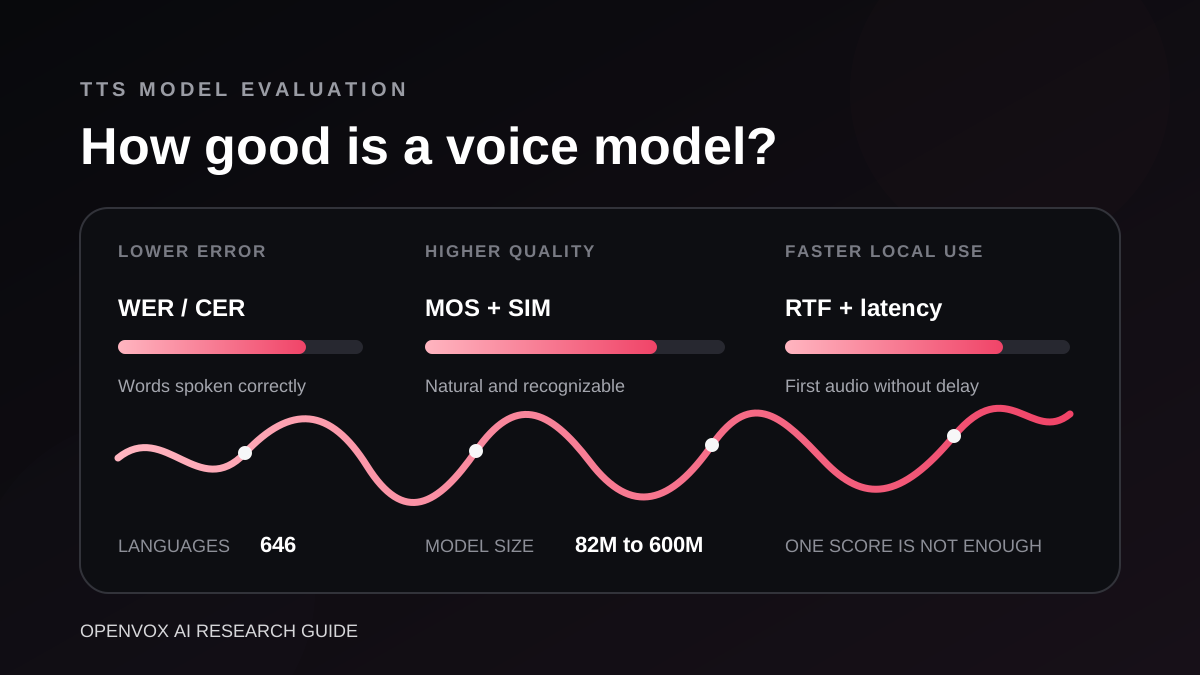
Automatic speech recognition is usually measured with word error rate, or WER. Lower is better. WER counts substitutions, deletions, and insertions relative to a reference transcript. Read our guide to speech model benchmarking for a deeper explanation of error rates, latency, real-time factor, and why normalization changes a score.
A fair warning is essential: not every number below is directly comparable. The Hugging Face Open ASR Leaderboard evaluates Whisper and Parakeet on the same English datasets and hardware, so that comparison is meaningful. NVIDIA's Nemotron 3.5 card reports FLEURS results at several streaming chunk sizes. Parakeet also reports FLEURS, but it uses a different language set and states that punctuation and capitalization are removed before scoring. We show these results for context, not as a single synthetic league table.
The primary sources are the official Whisper Large v3 Turbo model card, Parakeet TDT 0.6B v3 model card, Nemotron 3.5 ASR model card, and the Hugging Face Open ASR Leaderboard methodology.
Full specification comparison
| Parameter | Whisper Large v3 Turbo | Parakeet TDT 0.6B v3 | Nemotron 3.5 ASR |
|---|---|---|---|
| Parameters | 809M | 600M | 600M |
| Architecture | Encoder-decoder Transformer, pruned from Large v3 | FastConformer with TDT decoder | Cache-aware FastConformer with RNNT decoder and language prompt |
| Published language scope | 99 language tags | 25 European languages | 40 locales: 32 work out of the box, 8 require adaptation |
| Automatic language detection | Yes | Yes | Yes, or provide a locale prompt |
| Punctuation and capitalization | Yes | Yes | Yes |
| Native streaming design | No | No, chunked streaming inference is available | Yes, cache-aware streaming |
| Configurable streaming latency | Not native | Configured through chunked inference | 80ms, 160ms, 320ms, 560ms, or 1120ms chunks |
| Native timestamp documentation | Whisper timestamp tokens are supported by common runtimes | Word and segment timestamps documented | Not documented as a model-card output |
| Long-form use | Mature chunked long-form ecosystem | Up to 24 minutes with full attention or 3 hours with local attention on documented server hardware | Streaming duration is limited mainly by runtime and available memory |
| Speech translation | Whisper architecture supports translation to English | Transcription only | Transcription only |
| License | MIT | CC BY 4.0 | Open Model Development Weights License 1.1 |
| Best fit | General multilingual files and difficult edge cases | Fast European-language batch transcription and subtitles | Live captions, meetings, agents, and streaming microphones |
Accuracy: what the published WER numbers actually show
English Open ASR Leaderboard
| Model | Mean WER | AMI meetings | LibriSpeech clean | LibriSpeech other |
|---|---|---|---|---|
| Parakeet TDT 0.6B v3 | 6.34% | 11.31% | 1.93% | 3.59% |
| Whisper Large v3 Turbo | 7.83% | 16.13% | 2.10% | 4.24% |
On this common English evaluation, Parakeet wins the mean and the meeting-audio AMI subset. That makes it a strong default for interviews, meetings, lectures, and finished videos when the language is supported. The leaderboard reports Whisper Turbo at an inverse real-time factor of 200.19 on an NVIDIA A100, but local speed on a Mac or Windows PC will depend on the runtime, precision, audio length, and hardware.
European multilingual FLEURS results
Parakeet's official card reports an average FLEURS WER of 11.97% across its published language table. Selected scores include English 4.85%, Spanish 3.45%, Italian 3.00%, German 5.04%, French 5.15%, and Portuguese 4.76%. These are excellent results for a 600M-parameter local model.
Nemotron 3.5 trades some offline batch accuracy for native streaming behavior. At its most accurate documented 1.12-second setting with the language supplied, its transcription-ready group averages 8.84% on FLEURS. Selected results are Spanish 4.11%, Italian 4.25%, Portuguese 5.48%, English 7.91%, German 8.31%, and French 9.03%. Automatic detection raises the group average to 9.21%. These values should not be averaged together with Parakeet's table because the evaluated locale groups and normalization differ.
Noise and difficult recordings
Parakeet has the clearest published controlled noise test of the three. Its average English benchmark WER rises from 6.34% on clean audio to 7.12% at 10 dB SNR, 8.23% at 5 dB, 11.66% at 0 dB, and 19.88% at -5 dB. Whisper's official card emphasizes robustness to accents, background noise, and technical language, but also warns about hallucinated or repeated text. Nemotron is trained for challenging acoustic conditions, although its public card does not provide the same MUSAN SNR table.
Model-by-model analysis
Whisper Large v3 Turbo: the broad generalist
Whisper Turbo reduces Large v3's decoder from 32 layers to 4, cutting the checkpoint to 809M parameters and improving speed with a small accuracy tradeoff. Its largest advantage is coverage. The checkpoint carries 99 language tags, works across a wide range of audio tooling, and has mature implementations for chunking, timestamps, quantization, and CPU or GPU execution.
Coverage is not the same as equal accuracy. The official card says results are strongest in roughly ten languages and uneven for lower-resource languages, accents, and dialects. Whisper can also hallucinate plausible text during silence, noise, music, or badly segmented long recordings. Use it when you need the broadest fallback and test it carefully on the actual language and recording conditions.
Parakeet TDT 0.6B v3: the batch and subtitle specialist
Parakeet combines a FastConformer encoder with a token-and-duration transducer. Its 600M parameters are smaller than Whisper Turbo, its published English WER is lower, and it produces punctuation, capitalization, automatic language detection, and documented word and segment timestamps. Those properties make it especially attractive for editable transcripts and SRT subtitle generation.
Its constraint is geographic. The supported set is 25 European languages. If your work is mainly English, Spanish, French, German, Italian, Portuguese, Polish, Russian, Ukrainian, or another supported European language, Parakeet is often the first model to test. For Arabic, Hindi, Japanese, Korean, Mandarin, or many languages outside Europe, choose Whisper or Nemotron instead.
Nemotron 3.5 ASR: the streaming specialist
Nemotron 3.5 is also a 600M-parameter FastConformer model, but its cache-aware RNNT architecture is designed around continuous audio. It reuses encoder state instead of repeatedly processing overlapping buffers. You can choose an 80ms chunk for responsiveness or increase the chunk to 1120ms for better accuracy, without retraining the model.
NVIDIA lists 40 language-locales, but that number needs context. Nineteen locales are transcription-ready, thirteen have broad out-of-box coverage, and eight are adaptation-ready and require fine-tuning for full transcription. The 32 usable locales include English, Spanish, French, German, Arabic, Hindi, Japanese, Korean, Vietnamese, Mandarin, Turkish, Russian, Ukrainian, and several European languages. Nemotron is the strongest fit for live microphones, meetings, captions, and voice agents where streaming delay matters as much as final WER.
Speed, memory, and local hardware
Parameter count is a useful first approximation, not a complete hardware benchmark. Parakeet and Nemotron each have 600M parameters, while Whisper Turbo has 809M. Quantization can reduce memory, but the runtime also needs working memory for audio features, decoder state, caches, and long-form chunks. GPU implementations can behave very differently from CPU, Apple Silicon, Core ML, ONNX, or native C++ builds.
- Lowest-latency continuous audio: Nemotron 3.5, because streaming is part of its architecture.
- Fast completed-file processing: Parakeet, especially for supported European languages.
- Broad runtime availability: Whisper Turbo, because its ecosystem is older and more widely ported.
- Lowest theoretical model footprint: Parakeet and Nemotron tie by parameter count, but measure the actual build on your device.
Do not quote an H100 throughput chart as a laptop benchmark. NVIDIA reports that Nemotron can sustain 240 streams at an 80ms setting and 2,400 at 1120ms on one H100, but those numbers describe server concurrency. They prove the architecture is efficient; they do not predict the exact speed of your Mac or Windows PC.
Which local STT model should you choose?
- Choose Parakeet for English or supported European-language recordings, fast batch work, meetings, and timestamped subtitles.
- Choose Whisper Turbo when language coverage, ecosystem maturity, speech translation, or resilience across varied sources matters most.
- Choose Nemotron 3.5 for live transcription, microphone input, voice agents, and multilingual streaming where first-result latency matters.
- Test two models when the recording has heavy noise, overlapping speakers, a strong regional accent, music, or specialist vocabulary.
None of these models guarantees perfect transcription, and this comparison does not imply speaker diarization. If identifying who spoke is required, that is a separate processing stage. Always review names, numbers, legal terms, medical details, and quotations before publishing a transcript.
Use Whisper, Parakeet, and Nemotron locally in OpenVox
OpenVox turns these model choices into a desktop workflow. In the latest Mac and Windows apps, open AI Transcription, download the model you want, and import an audio or video file or record directly from your microphone. After the model download, processing stays on your device. Your source media and transcript are not uploaded to a transcription service.
- Download OpenVox for Mac or Windows and open AI Transcription.
- Download Whisper Large v3 Turbo, Parakeet TDT 0.6B v3, or Nemotron 3.5 for your workflow.
- Import audio or video, or record from the microphone.
- Select the spoken language or use automatic detection.
- Generate and edit the transcript.
- Copy the text, export TXT, or create timestamped SRT subtitles.
- Send the transcript into AI Speech or use it as the starting point for AI Dubbing.
OpenVox is free to try. Pro remains a one-time $19.99 purchase per platform, with no recurring transcription subscription. See the OpenVox pricing and license details, or check desktop hardware requirements before downloading a larger model.
A practical test before committing to one model
Published benchmarks are a starting point. Build a ten-minute test set from your real work: clean speech, a noisy clip, multiple accents, names, numbers, domain terms, and a long uninterrupted section. Run every candidate with the same audio and normalization, then compare corrections per minute, processing time, peak memory, punctuation, and timestamp drift. The best local STT model is the one that minimizes total editing time on your material.
When evaluating the complete application rather than only the checkpoint, use our guide on choosing private speech software. Developers building voice agents can also continue with the local speech API guide.