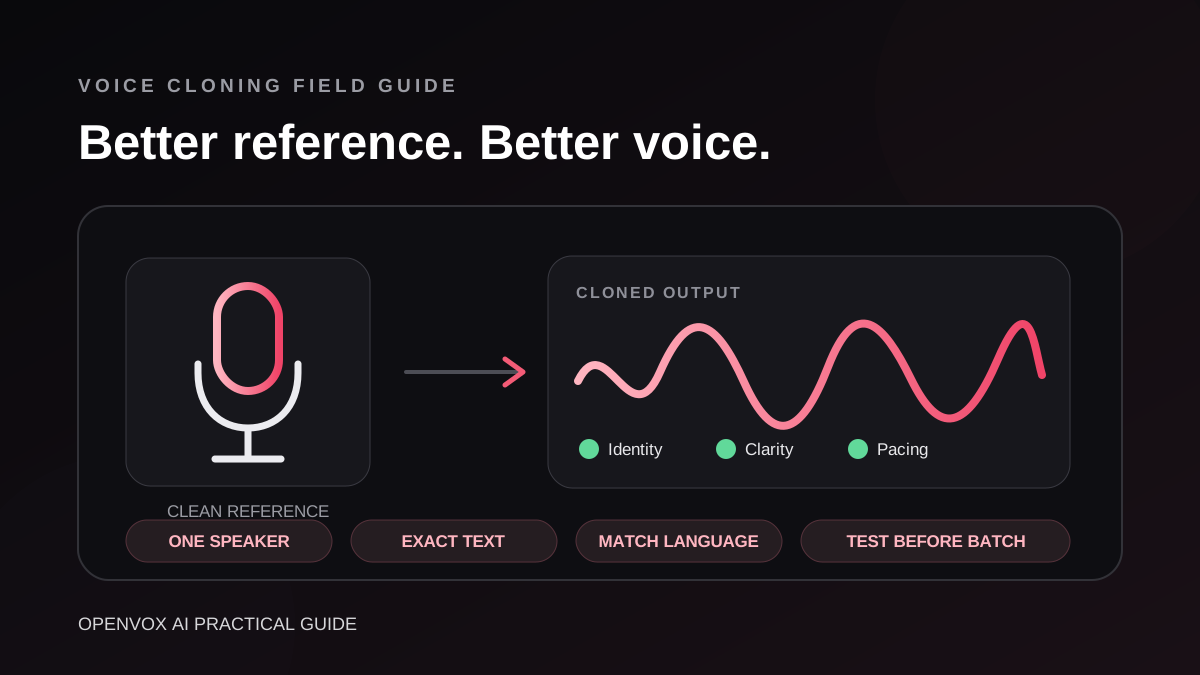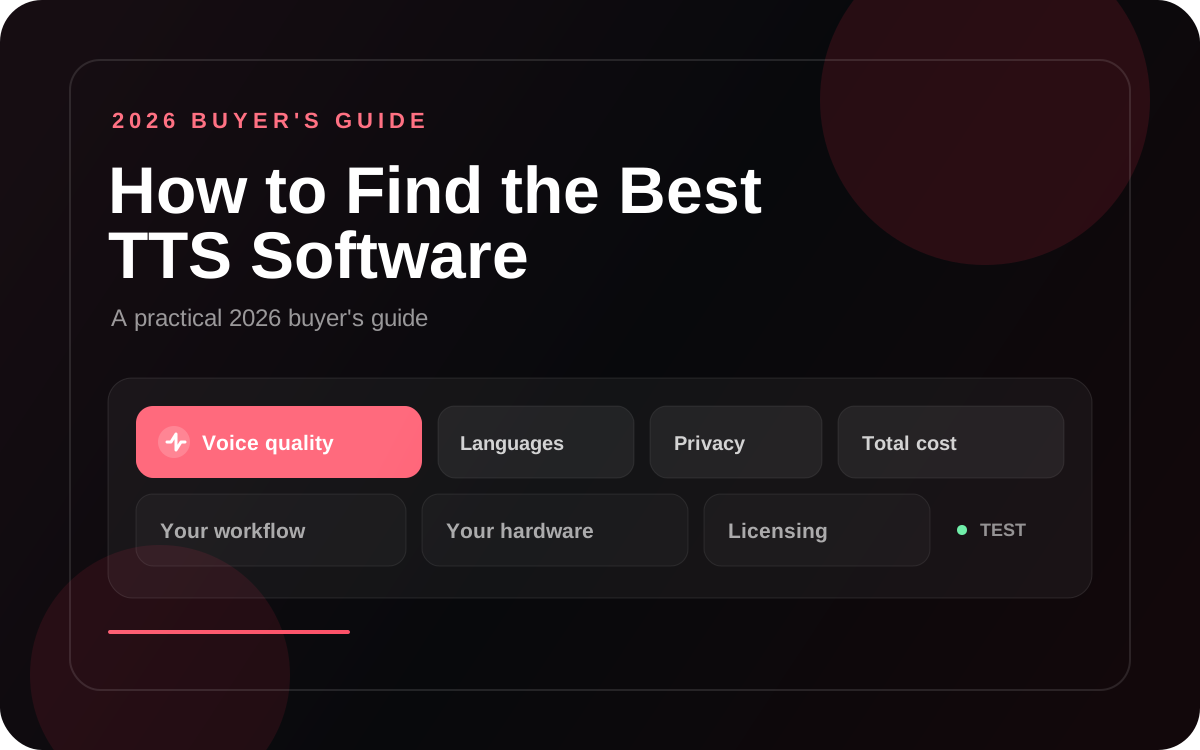
Responsible use
Responsible voice cloning checklist
Local processing helps privacy, but it does not replace consent or user responsibility.
Do
Use it responsibly
- Use your own or a permissioned voice.
- Keep consent records for client work.
- Label synthetic audio when confusion is possible.
- Prefer local processing when privacy matters.
Don't
Local is not permissionless
- Do not imitate real people without consent.
- Do not use cloned voices for scams or fake endorsements.
- Do not treat “private” as a moral exemption.
- Do not publish synthetic speech that misleads listeners.
Voice cloning ethics is not a side topic anymore. The technology is now good enough that cloned voices can sound convincing, useful, and emotionally persuasive. That is what makes the category exciting. It is also what makes the category risky.
A cloned voice can help a creator move faster, let a team preserve a recognizable sound, or give someone a more flexible synthetic speaking voice. But the same capability can also be used to imitate people without consent, mislead listeners, or create audio that sounds more legitimate than it really is. The conversation aroundAI voice cloning privacy therefore has to include both technology design and human responsibility.
The right question is not whether voice cloning is powerful. It clearly is. The real question is whether we are disciplined enough to use that power with consent, disclosure, and restraint.
Why AI voice cloning is powerful
Voice is intimate. People recognize it quickly, attach trust to it easily, and notice subtle identity cues that text alone does not carry. That is why cloned voices can be so valuable in legitimate workflows.
- Let creators build a consistent narrator voice without recording every line manually.
- Help teams preserve a recognizable voice identity across products, tutorials, or accessibility workflows.
- Give individuals a reusable voice asset for content, automation, or assistive communication.
- Reduce friction in multilingual or high-volume voice production where re-recording everything is unrealistic.
None of that is inherently unethical. The issue is that voice carries identity. When software can replicate the sound of a real person, permission and context stop being optional details.
Why consent matters so much
Voice cloning without consent is not just a technical shortcut. It can be a form of impersonation. Even when the content itself is not malicious, the use of someone's voice without permission can create reputational, emotional, legal, and commercial harm.
This concern is not theoretical. OpenAI's official public materials about synthetic voices have emphasized that partners testing broader voice-cloning style tools were required to obtain explicit and informed consent, clearly disclose AI-generated voices, and avoid impersonation without consent or legal right. That is the right baseline for the entire category, not just one company.
In practice, voice cloning consent should mean more than a vague verbal okay. If the voice is not yours, permission should be explicit, informed, and tied to a real use case. The speaker should know how the voice will be used, what material it may speak, where it may be published, and how long the project lasts.
Risks of cloud voice cloning
Cloud cloning tools are not automatically unsafe, but they create an extra privacy layer to think through. When you upload a voice sample and generate cloned audio on a hosted system, you now have to consider storage, retention, account controls, access permissions, and whether private samples or outputs are sitting on a third-party platform longer than you expect.
That matters even more for client work, internal projects, unpublished media, or personal recordings. Privacy risk is not only about whether a provider is malicious. It is also about whether the workflow shares more than it needs to share by default.
How local processing improves privacy
Privacy boundary
What local processing helps with
Privacy is important, but ethics still depends on how the person using the tool behaves.
Local processing improves privacy
- Voice samples and output can stay on your Mac for core workflows.
- It reduces the need to upload private audio by default.
- It gives you clearer local control over storage and deletion.
But it does not solve ethics
- A local tool can still be misused for impersonation or deception.
- You still need consent, disclosure, and clear boundaries.
- Private infrastructure does not excuse deception.
Local processing does not solve every ethics problem, but it does improve the privacy story. OpenVox's current privacy and product pages describe core voice workflows as local-first: cloned voices, training data, saved voice assets, and generated audio are stored locally on the Mac for core use, and the app states that it does not collect analytics or tracking data from inside the application.
That matters because fewer voice samples need to be uploaded to third-party systems by default. It also gives the user more direct control over storage, deletion, and local project boundaries. If a voice asset is sensitive, a local-first architecture is simply a cleaner fit.
What local processing does not solve
A private tool can still be used irresponsibly. Responsible voice cloning is not guaranteed by the runtime location alone. A person can misuse a local workflow just as easily as a hosted one if the ethics are wrong.
Local processing reduces unnecessary sharing. It does not create consent where none exists. It does not make impersonation acceptable. It does not excuse deception. A local-first design supports better privacy, but the operator still has to make better decisions.
Recommended responsible-use checklist
- Use your own voice or a voice you have explicit permission to use.
- Do not impersonate a real person or organization without consent or legal right.
- Label synthetic voice content when the audience could reasonably assume it is a real human recording.
- Avoid scams, deception, fake endorsements, political manipulation, or misleading “live” performance claims.
- Keep written consent records for client projects, internal teams, or commissioned voice work.
- Delete voice assets when the project or permission period ends.
For teams and freelancers, one item deserves special emphasis: keep consent records. If a client, actor, narrator, or collaborator has given permission for a voice clone, store that approval in a form you can actually retrieve later. Responsible process is much easier when the documentation exists before a dispute ever appears.
Why OpenVox is well positioned for privacy-first voice work
OpenVox is not “ethical by magic,” but it is well positioned for privacy-first usage because the architecture is local-first. The current site and privacy policy describe cloned voices, audiobook data, generated audio, and core speech workflows as stored and processed locally on the device, with no analytics or tracking inside the app.
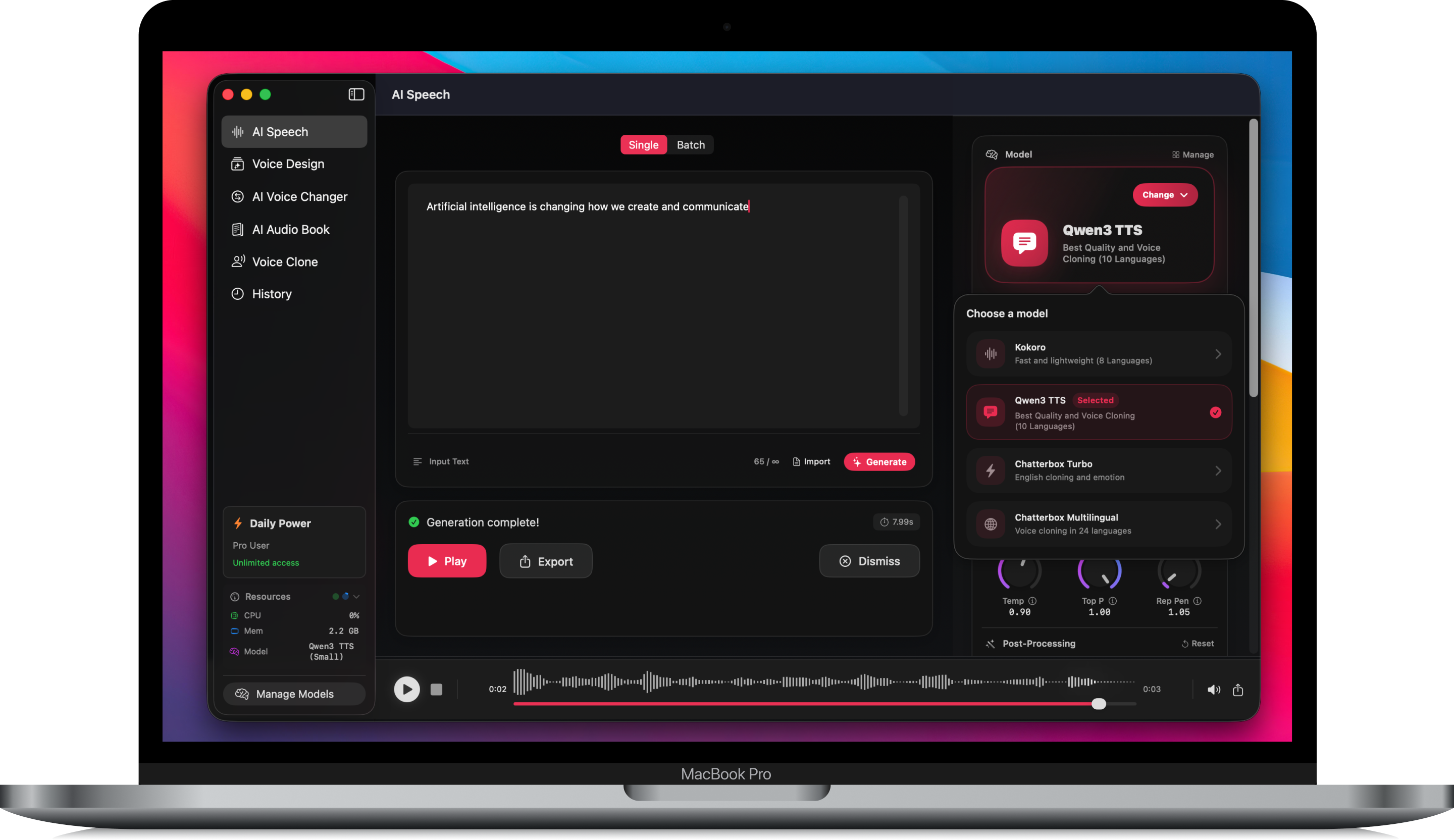
That gives OpenVox a stronger default posture for people who care about synthetic voice safety. It does not mean “anything local is automatically okay.” It means the product is aligned with the idea that voice samples and generated outputs should not be uploaded, retained, or tracked more than necessary.
The practical conclusion
The future of voice cloning depends on trust. People will only keep using these tools if the industry treats consent, disclosure, and privacy as product fundamentals rather than annoying disclaimers. That is true for developers, creators, agencies, and app makers alike.
If you use cloned voices, the baseline is simple: use your own voice or a permissioned one, avoid deception, be clear when synthetic speech could be mistaken for a real recording, and keep the workflow as private as it reasonably can be. OpenVox supports that direction by keeping core voice work local, but the final ethical decision still belongs to the person using the tool.
Source note: the consent and disclosure framing above references official OpenAI materials about synthetic voices and current OpenVox privacy and product copy checked on May 25, 2026.