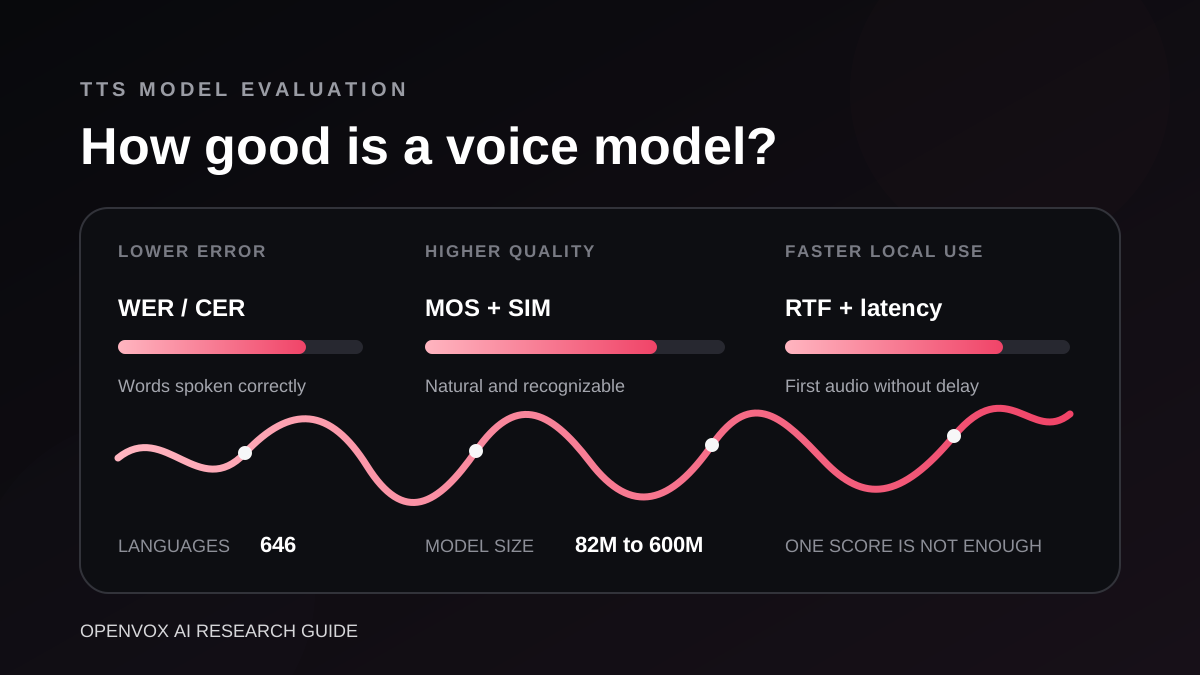

The TTS market in 2026 is no longer a simple contest between one or two cloud APIs. There are now serious local models, lightweight CPU options, expressive research systems, enterprise cloud APIs, creator platforms, and realtime voice-agent engines. The hard part is not finding a model. The hard part is choosing the right one for your workflow.
This guide restructures the research into a practical decision framework. Scores are subjective and should be treated as a starting point, not a laboratory benchmark. Voice quality measures how natural the output can sound. Expressive control measures how well the system handles emotion, delivery, intensity, pacing, style, and direction.
The best TTS model is not the model with the highest single demo. It is the model whose quality, control, license, latency, privacy profile, and setup cost match the work you actually need to ship.
Best local realism
OmniVoice
Realistic, emotion-aware speech with the broadest local language coverage.
Best small hardware
Supertonic 3
Blazing Fast, compact, and practical when local deployment matters most.
Best cloud polish
ElevenLabs
Still the easiest premium cloning workflow, but expensive at serious volume.
How to read the scores
A voice-quality score above 7 means many listeners will accept the output as high quality. A score above 8 means the model can sound human-like in the right conditions, though style, expression, and delivery often reveal the synthetic origin. For expressive control, a score above 7 means the system is useful for directed performance, while an 8 or higher approaches voice-acting synthesis.
| Need | Start with | Why |
|---|---|---|
| Private local speech production | OpenVox-supported models | Local workflows keep text, voice samples, and generated audio under your control. |
| Best free open-source starting point | Chatterbox TTS | Strong quality, cloning direction, and a realistic path into local experimentation. |
| Best local realism with emotion control | OmniVoice | More realistic than Chatterbox in many workflows, with emotion-aware generation and 646 languages. |
| Weak hardware or CPU-first work | Kokoro TTS or PocketTTS | Both make local speech practical without treating a GPU as mandatory. |
| Maximum language coverage | OmniVoice or Azure | OmniVoice is the local-first coverage answer; Azure is the enterprise cloud catalog answer. |
| Cloud emotional speech | Hume Octave | Its control direction is unusually strong for emotion-led voice output. |
| Realtime voice agents | Cartesia, Deepgram, OpenAI, Hume, or Grok | These APIs are built around interactive latency and application integration. |
OpenVox-supported local models
The sections below are ranked from lowest to best by voice-quality score. OpenVox-supported model families are clearly marked, so readers can move directly from evaluation to a private local workflow.
Piper
Simple local speech, home automation, basic readers, and very low requirements.
Important features / USP
- MIT-licensed fast local neural TTS system with many community voices.
- Practical for home automation, accessibility, embedded systems, and simple readers.
- Lower realism ceiling, but very useful when reliability and simplicity matter.
Quality
4.5
Control
0.0
Lang.
37
Piper will not win a realism contest, but it remains useful because it is local, fast, simple, and practical.
OuteTTS
Small LLM-based TTS experiments and embedded hardware exploration.
Important features / USP
- LLM-style TTS model with llama.cpp-friendly runtime options and GGUF-oriented community interest.
- Model licensing varies by variant, from CC BY-SA 4.0 to CC BY-NC-SA 4.0.
- Interesting for embedded and llama.cpp experiments, but output quality is not top tier.
Quality
5.0
Control
1.0
Lang.
23
Interesting technically and friendly to llama.cpp-style experimentation, but not a top-tier output model.
Bark
Expressive research audio, nonverbal sounds, and unusual experiments.
Important features / USP
- MIT-licensed text-prompted generative audio model.
- Can produce multilingual speech, music-like audio, background sounds, and nonverbal cues.
- Creative and expressive, but less reliable for controlled production narration.
Quality
6.5
Control
4.0
Lang.
13
Fun and occasionally impressive, but too unreliable for serious narration pipelines.
MeloTTS
Lightweight multilingual TTS.
Important features / USP
- MIT-licensed multilingual TTS library from MyShell.
- Simple, practical support for core languages including English, Spanish, French, Chinese, Japanese, and Korean.
- Useful as a lightweight multilingual baseline, not a high-expression voice acting model.
Quality
6.5
Control
0.0
Lang.
6
A useful basic model, but not a modern expressive voice-acting solution.
Parler-TTS
Style-prompted TTS experiments.
Important features / USP
- Apache-licensed prompt-controlled TTS from Hugging Face.
- Generates speech from natural-language descriptions of gender, pitch, speaking style, pace, and acoustics.
- Great control concept, though voice consistency can vary across generations.
Quality
6.8
Control
4.5
Lang.
8
The promptable-control idea is valuable, but voice consistency and final output lag behind the strongest current systems.
Kokoro TTS
OpenVox supportedCPU-friendly reading, accessibility, simple narration, and lower-end hardware.
Important features / USP
- 82M-parameter lightweight model designed for fast, low-cost local inference.
- Apache-licensed weights suitable for production and personal projects.
- Best fit for simple reading, batch generation, and low-resource devices.
Quality
7.0
Control
0.0
Lang.
9
Kokoro is not a voice-acting model, and it does not clone voices. Its value is speed, size, and dependability. If a workflow needs local speech on modest hardware, Kokoro belongs near the top of the test list.
Supported in OpenVox
Try Kokoro TTS locally with OpenVox.
OpenVox gives you a local-first interface for supported model families, downloads, voice selection, history, export, and private speech generation on Mac, iPad, and Windows.


XTTS v2 / Coqui TTS
Older cloning workflows and community experiments.
Important features / USP
- Cross-language voice cloning from short reference clips across 17 languages.
- Coqui Public Model License 1.0.0 permits non-commercial use only.
- Historically important, but licensing and maintenance make it risky for commercial workflows.
Quality
7.0
Control
1.0
Lang.
17
Historically important, but commercial use deserves caution because licensing and maintenance realities have become less clean over time.
StyleTTS 2
English TTS comparisons, fine-tuning experiments, and model-family research.
Important features / USP
- MIT-licensed research model focused on style diffusion and adversarial training.
- Important foundation for later local TTS families such as Kokoro and Chatterbox-style approaches.
- Still useful for architecture comparisons and fine-tuning experiments.
Quality
7.5
Control
2.0
Lang.
14
Historically important and still useful as a technical reference. In 2026, most users should start with newer descendants or better-packaged systems unless they specifically want to compare architectures.
GPT-SoVITS
Few-shot cloning and Asian-language ecosystems.
Important features / USP
- MIT-licensed WebUI for few-shot voice conversion and TTS.
- Strong fit for Asian-language voice cloning ecosystems and hands-on model tuning.
- Powerful if you can tolerate setup complexity and workflow rough edges.
Quality
7.5
Control
2.0
Lang.
5
Still relevant if you are willing to work through the stack. Useful, capable, and not especially polished.
F5-TTS
Zero-shot cloning experiments with short reference audio.
Important features / USP
- Flow-matching TTS architecture with strong zero-shot cloning direction.
- Code is MIT-licensed, but common released model weights are CC BY-NC 4.0.
- Useful for research and experimentation; avoid commercial deployment unless licensing is resolved.
Quality
7.5
Control
2.0
Lang.
2
A good cloning direction, but non-commercial terms and research-software roughness make it a careful choice for production.
Spark-TTS
Voice cloning, speaker attributes, and research comparisons.
Important features / USP
- Apache-licensed LLM-based TTS system built around efficient speech-token generation.
- Supports zero-shot voice cloning and controllable speaker attributes such as gender, pitch, and speaking rate.
- Best for bilingual Chinese-English cloning and speaker-control research.
Quality
7.6
Control
4.0
Lang.
2
Interesting because of speaker-attribute control, though still more research-side than creator-ready.
Orpheus TTS
Expressive open-source speech experiments.
Important features / USP
- Llama-based speech-LLM direction with empathetic, expressive TTS.
- Code is Apache-licensed, while weights inherit Llama-family licensing constraints.
- Interesting for modern expressive speech experiments and realtime-style generation.
Quality
7.8
Control
4.0
Lang.
8
A modern direction worth testing, especially for expressive English and community speaker models. Expect experimentation, not a finished consumer workflow.
PocketTTS
OpenVox supportedCPU-only local TTS, low-latency cloning, browser-style experiments, and compact assistant voices.
Important features / USP
- 100M-parameter CPU-first model with voice cloning abilities.
- Designed to avoid GPU and cloud API dependency for compact local apps.
- Ranked higher than its raw quality score because it is stable, CPU-only, and still supports local voice cloning.
Quality
6.0
Control
2.0
Lang.
6
PocketTTS is strongest when deployment simplicity matters more than theatrical range. It sounds better than older lightweight systems, supports cloning in a compact package, and is practical for local agents on modest machines.
Supported in OpenVox
Try PocketTTS locally with OpenVox.
OpenVox gives you a local-first interface for supported model families, downloads, voice selection, history, export, and private speech generation on Mac, iPad, and Windows.
Chatterbox TTS
OpenVox supportedFree local TTS, voice cloning experiments, Linux pipelines, and production-minded local workflows.
Important features / USP
- MIT-licensed local TTS family with zero-shot voice cloning.
- Emotion exaggeration control and practical variants for multilingual and faster workflows.
- Strong open-source starting point when you want cloning and quality without cloud lock-in.
Quality
8.0
Control
2.0
Lang.
23
One of the best open-source starting points if you want quality without immediately renting cloud infrastructure. The model is strong, but production polish still depends on segmentation, retries, silence handling, pronunciation cleanup, and good orchestration.
Supported in OpenVox
Try Chatterbox TTS locally with OpenVox.
OpenVox gives you a local-first interface for supported model families, downloads, voice selection, history, export, and private speech generation on Mac, iPad, and Windows.
Supertonic 3
OpenVox supportedUltra-fast multilingual TTS, voice agents, assistants, API workflows, audiobooks, and batch generation.
Important features / USP
- 31-language local TTS model built around very fast generation and near real-time loading.
- Excellent fit for agents, assistants, local APIs, audiobook batches, and fast iteration loops.
- Its USP is simple: fast generation in many languages at blazing speeds.
Quality
6.9
Control
1.0
Lang.
31
Its main advantage is not theatrical expressiveness. It is the ability to generate speech across many languages at blazing speeds, with near real-time loading that makes iterative local workflows feel instant.
Supported in OpenVox
Try Supertonic 3 locally with OpenVox.
OpenVox gives you a local-first interface for supported model families, downloads, voice selection, history, export, and private speech generation on Mac, iPad, and Windows.
VibeVoice TTS
OpenVox supportedLong-form multi-speaker dialogue, podcasts, and Windows workflows.
Important features / USP
- Windows-only OpenVox model for long-form multi-speaker generation.
- Supports up to four distinct speakers for podcasts, dialogue, and character-driven scripts.
Quality
8.3
Control
4.0
Lang.
2
VibeVoice TTS is a specialized Windows-only OpenVox model for long-form multi-speaker generation, supporting up to four speakers and extended scripted audio. It is a better fit for dialogue than for ordinary single-speaker narration.
Supported in OpenVox
Try VibeVoice TTS locally with OpenVox.
OpenVox gives you a local-first interface for supported model families, downloads, voice selection, history, export, and private speech generation on Mac, iPad, and Windows.
CosyVoice 3
Multilingual research, zero-shot voice work, and serious model evaluation.
Important features / USP
- Apache-licensed Alibaba/FunAudioLLM model family with multilingual zero-shot voice cloning.
- Supports low-latency streaming and instruction-style controls for language, dialect, emotion, speed, and volume.
- Strong research and production-oriented toolkit, but less casual than desktop-first tools.
Quality
8.0
Control
4.0
Lang.
9
A strong Alibaba model family with good cloning and credible sample quality. It is more research and engineering tool than casual desktop product.
Dia
Dialogue, multi-speaker scenes, reactions, laughter, and character-style speech.
Important features / USP
- Apache-licensed 1.6B dialogue-focused TTS model.
- Generates realistic multi-speaker dialogue and nonverbal sounds such as laughter and coughs.
- Best for scripted scenes and character interactions rather than plain narration.
Quality
8.0
Control
5.0
Lang.
1
Excellent for dialogue-like output and scene audio, less compelling as a general-purpose single-speaker narration model.
MOSS TTS 1.5
OpenVox supportedStudio-grade Mac narration, voice cloning, multilingual speech, and long-form audiobook work.
Important features / USP
- 31-language local synthesis with native 48 kHz stereo output on Mac.
- Stronger voice-cloning stability, long-form control, and explicit pause markers.
- Mac-only in OpenVox; the model is released under Apache License 2.0 for commercial use.
Quality
9.0
Control
7.0
Lang.
31
MOSS TTS 1.5 is the quality-first OpenVox option for Mac users. It combines 31-language support, stable cloning, explicit pause control, and native 48 kHz stereo output. The tradeoff is a heavier model and Mac-only availability in OpenVox.
Supported in OpenVox
Try MOSS TTS 1.5 locally with OpenVox.
OpenVox gives you a local-first interface for supported model families, downloads, voice selection, history, export, and private speech generation on Mac, iPad, and Windows.
IndexTTS 2.5
Chinese, English-Chinese cloning, multilingual work, and research.
Important features / USP
- Emotionally expressive zero-shot TTS with duration-control work for dubbing and sync-sensitive workflows.
- Separates speaker identity from emotion prompts for better timbre and style control.
- Commercial use requires careful license review and, in many cases, written authorization.
Quality
8.0
Control
4.0
Lang.
4
Solid sample quality and a strong technical direction, with restricted terms that keep it in the engineering and research lane for many teams.
Fish Speech / OpenAudio
Multilingual TTS, cloning, streaming, and instruction-following speech research.
Important features / USP
- Strong multilingual cloning and streaming direction with instruction-following speech work.
- Released under the Fish Audio Research License, so commercial use requires a separate agreement.
- Best treated as a high-quality research benchmark unless you have commercial permission.
Quality
8.3
Control
5.0
Lang.
13
One of the stronger modern open-weight directions. The catch is licensing: non-commercial or restricted terms make it less straightforward for commercial production.
Qwen3 TTS
OpenVox supportedCustom voices, multilingual experiments, voice design, and advanced local research.
Important features / USP
- Apache-licensed model family with expressive speech, streaming generation, voice design, and cloning.
- Useful for custom reusable voices and advanced voice-design workflows.
- Ranked above VibeVoice because it is more useful as a general-purpose local TTS, voice design, and cloning model.
Quality
8.5
Control
6.0
Lang.
9
Qwen3 is powerful but uneven. Its voice-design path offers meaningful expressive control, while cloning can sound strong but often gives up direct expression controls. It is best for people willing to tune, test, and accept a less ordinary setup.
Supported in OpenVox
Try Qwen3 TTS locally with OpenVox.
OpenVox gives you a local-first interface for supported model families, downloads, voice selection, history, export, and private speech generation on Mac, iPad, and Windows.
OmniVoice
OpenVox supportedRealistic local speech, emotion-aware generation, massive language coverage, accessibility workflows, and global products.
Important features / USP
- 646-language coverage for global, regional, and underserved language workflows.
- Emotion-aware speech generation with a more realistic ceiling than Chatterbox in many OpenVox workflows.
- Best OpenVox choice when realism, emotion control, and language coverage all matter.
Quality
8.4
Control
4.0
Lang.
646
OmniVoice is the strongest all-around local model family in OpenVox when you need realism, emotion control, and language coverage together. It sits above Chatterbox for naturalness in many workflows while also making regional, long-tail, and underserved languages available inside a private local pipeline.
Supported in OpenVox
Try OmniVoice locally with OpenVox.
OpenVox gives you a local-first interface for supported model families, downloads, voice selection, history, export, and private speech generation on Mac, iPad, and Windows.
Higgs Audio v3 TTS
Non-commercial multilingual voice agents, expressive tags, zero-shot cloning, and research.
Important features / USP
- 100-language expressive model with inline control for style, emotion, pauses, pitch, and speed.
- Released under a research and non-commercial license for local experimentation.
- Technically impressive for voice-agent research, but not ready for ordinary commercial deployment.
Quality
8.5
Control
6.5
Lang.
100
Technically impressive, with inline controls for emotion, pauses, pitch, speed, and style. It is also heavy, research-oriented, and commercially restrictive.
Cloud TTS models
Cloud systems remain useful for fast demos, enterprise integrations, and voice-agent APIs. The tradeoff is control. Your voice, text, pricing, quota, and account access are mediated by a provider. That can be acceptable for a prototype or a hosted product, but it is a real dependency for serious speech production. The table is ranked from lowest to best by voice-quality score. Cloud entries are listed under the provider terms that govern commercial API or app use, rather than an open model-weight license.
CapCut TTS
Quick short-form videos where originality is not the priority.
Starter cost: $0 free TTS; CapCut Pro commonly $19.99/mo
Quality
5.5
Control
0.0
Lang.
15
NaturalReader
Personal reading and accessibility rather than production narration.
Starter cost: Personal Plus $20.90/mo; Commercial Starter $29/user/mo
Quality
6.8
Control
1.0
Lang.
90
Amazon Polly
Simple AWS TTS, stable API use, and inexpensive basics.
Starter cost: 12-month free tier; Standard $4/1M chars, Neural $16/1M chars
Quality
7.0
Control
2.0
Lang.
41
Speechify
Personal reading, accessibility, and document listening.
Starter cost: $0 free; Premium $29/mo or $159/year
Quality
7.0
Control
2.0
Lang.
60
LOVO / Genny
Browser-based creator voiceovers with a large catalog.
Starter cost: Free plan; Basic paid plans commonly start around $24-$29/mo
Quality
7.2
Control
4.0
Lang.
100
Descript
Creator editing workflows that already live inside Descript.
Starter cost: $0 free plan; Hobbyist $24/mo or $16/mo billed annually
Quality
7.3
Control
3.0
Lang.
19
Murf
Marketing, training, and easy browser-based voiceovers.
Starter cost: $0 free plan; Studio Starter $19/mo billed annually
Quality
7.4
Control
5.0
Lang.
35
Google Cloud Text-to-Speech
Enterprise coverage and Google Cloud infrastructure.
Starter cost: Gemini TTS from $1/M input text tokens + $20/M audio tokens
Quality
7.5
Control
3.0
Lang.
50
WellSaid
Corporate voiceovers and e-learning production.
Starter cost: $19/mo Starter monthly or $10/mo billed annually
Quality
7.6
Control
4.0
Lang.
20
Deepgram Aura
Realtime API speech and existing Deepgram customers.
Starter cost: $200 free credit; Aura-1 from $0.015/1K characters
Quality
7.7
Control
3.0
Lang.
7
Azure Speech
Enterprise catalogs and Microsoft-stack integration.
Starter cost: Pay as you go: Neural TTS $12/1M characters at 80M-character tier
Quality
7.8
Control
3.5
Lang.
100
PlayHT
Creator voiceovers, API workflows, and commercial web tooling.
Starter cost: Free plan available; paid creator plans commonly start around $39/mo
Quality
7.8
Control
4.0
Lang.
37
OpenAI TTS
Apps, agents, and teams already building on OpenAI APIs.
Starter cost: Pay as you go: GPT-4o mini TTS $0.60/M text input + $12/M audio output tokens
Quality
8.0
Control
5.0
Lang.
7
Resemble AI
Enterprise cloning, provenance, and detection-oriented workflows.
Starter cost: Flex pay-as-you-go starts at $5 credit load
Quality
8.0
Control
6.0
Lang.
23
Gemini TTS
API speech generation, multi-speaker direction, and Google workflows.
Starter cost: Free tier; paid Gemini TTS from $1/M input text tokens + $20/M audio tokens
Quality
8.1
Control
6.5
Lang.
70
xAI Grok Voice
Cheaper cloud voice API tests with a small voice catalog.
Starter cost: Pay as you go: TTS $15/1M characters
Quality
8.3
Control
6.0
Lang.
20
Hume Octave
Emotional speech, expressive direction, and agent voices.
Starter cost: $3/mo Starter; commercial use from Creator at $7/mo
Quality
8.6
Control
9.0
Lang.
11
Cartesia Sonic
Realtime voice agents, low latency, and interactive API use.
Starter cost: $0/mo Free; Pro starts at $5/mo
Quality
8.8
Control
7.0
Lang.
42
ElevenLabs
Easy cloud cloning, browser workflows, and fast premium demos.
Starter cost: $5/mo Starter
Quality
9.0
Control
7.5
Lang.
74
What I would use
- For the strongest OpenVox local realism with emotion control, start with OmniVoice.
- For a private creator or developer workflow, start with OpenVox-supported local models.
- For free local tinkering, start with Chatterbox TTS.
- For tiny hardware or fast CPU speech, start with Kokoro TTS or PocketTTS.
- For a simple local reader, Piper is still useful even if it is not realistic by 2026 standards.
- For high-quality custom local voices, test Qwen3 TTS, CosyVoice 2, and Fish Speech with licensing in mind.
- For a quick cloud cloning test, ElevenLabs remains the easiest path, but watch the bill carefully.
- For emotional cloud speech, test Hume Octave.
- For realtime cloud agents, compare Cartesia, Deepgram, OpenAI, Grok, and Hume against your latency budget.
- For corporate cloud basics, Azure, Google Cloud Text-to-Speech, and Amazon Polly are still safe infrastructure choices.
The local versus cloud decision
Cloud TTS looks attractive because it starts quickly. The long-term friction is different: recurring costs, account risk, provider policy changes, voice availability, usage caps, and data-handling constraints. Local TTS asks for more setup up front, but gives you ownership once the model is installed.
That is why the strongest 2026 workflow is often hybrid during evaluation and local during production. Use cloud systems to understand the ceiling. Use local models when privacy, cost control, offline reliability, or reusable production workflows matter. For OpenVox users, the practical advantage is that the supported local model families can live in one app instead of scattered scripts and fragile environments.